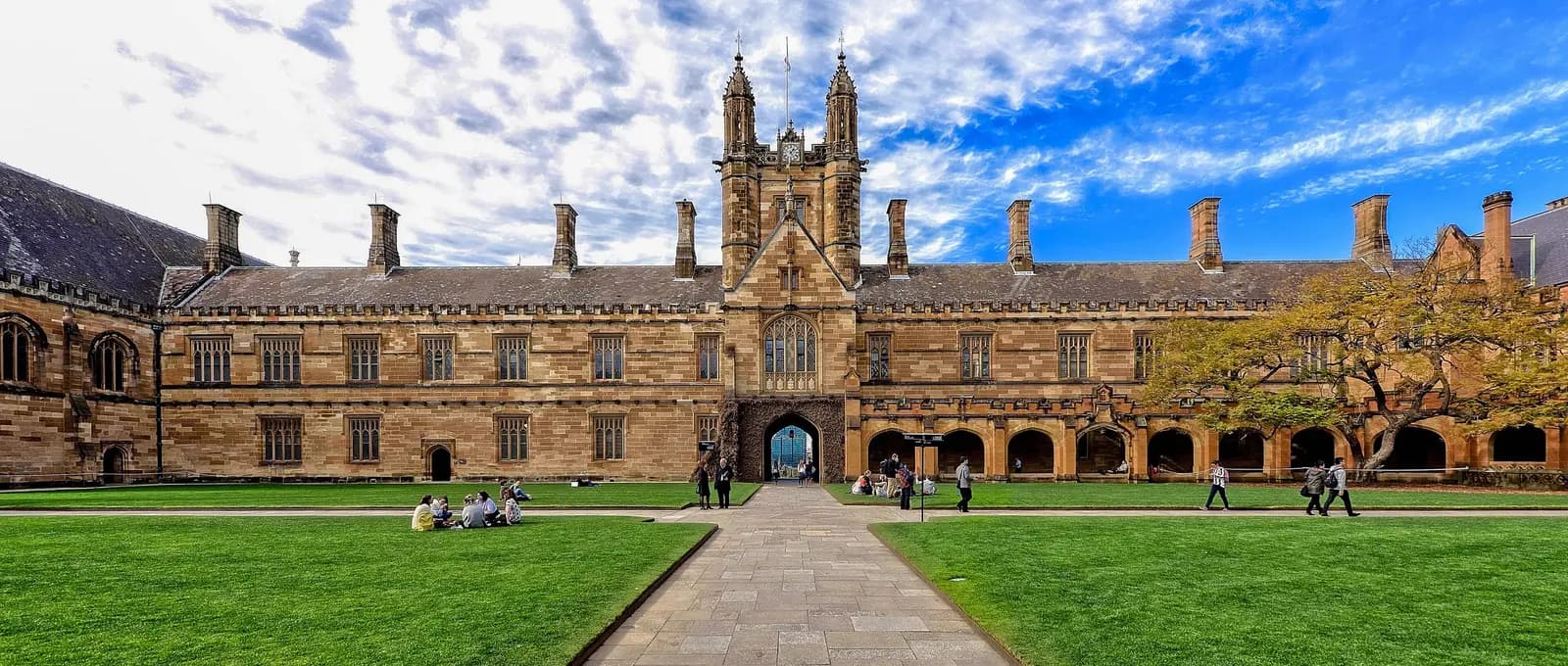
Photo: Main Quadrangle, University of Sydney by Jason Tong, CC BY 2.0 (edited)
Your Global Education Journey Starts Here
Australia is a popular destination for international students seeking quality education, practical learning, and a multicultural student experience. With universities and specialist institutions offering programmes across business, engineering, information technology, healthcare, science, and creative fields, students can explore a wide range of academic pathways.
From vibrant cities such as Sydney, Melbourne, Brisbane, Perth, and Adelaide to regional study destinations, Australia offers different environments to suit students' academic interests, budgets, and lifestyle preferences.
At UniAbroadly, we help you explore suitable courses, shortlist universities, prepare applications, understand education funding options, and navigate the student visa process.
Australia offers a higher education system with a focus on academic quality, research, practical learning, and student support. Many programmes include projects, laboratory work, internships, or industry-related learning, depending on the course and institution.
International students can choose from undergraduate degrees, postgraduate qualifications, vocational education, and research programmes. Courses are available across a variety of fields, with English as the primary language of instruction for most international higher education programmes.
Australia also has a diverse international student community, giving students opportunities to meet people from different backgrounds and experience a new culture.
Choosing the right programme means considering more than rankings. Tuition fees, entry requirements, location, course content, accommodation, and career goals should all be part of your decision.
UniAbroadly helps you compare your options and plan your study abroad journey with greater clarity.
Understand your academic profile, interests, budget, and long-term goals before selecting a study pathway.
Understand the English-language requirements for your chosen institution and explore suitable preparation resources.
Compare universities and courses based on eligibility, tuition fees, location, curriculum, and career interests.
Get guidance with application forms, supporting documents, deadlines, and submission requirements.
Explore funding opportunities and understand the eligibility requirements for each scholarship.
Research education financing options and prepare the information lenders may request.
Understand the Australian student visa process, financial evidence requirements, health cover, and supporting documents.
Plan your accommodation, travel, and practical arrangements before departure.
English-language requirements vary by university, course, and visa circumstances. Some institutions accept IELTS, PTE Academic, TOEFL iBT, or other approved evidence, while others may have specific score requirements.
Preparing early can help you understand the test format, identify areas for improvement, and plan around application deadlines.
UniAbroadly can help you understand which English-language evidence your chosen programme requires and explore suitable preparation options.
Only advertise test-preparation classes, mock tests, or free demos if UniAbroadly actually provides them.
Australia offers programmes across a broad range of academic and professional fields.
Popular areas include:
Course availability, accreditation, professional registration requirements, and entry criteria differ by institution and field.
A bachelor's degree in Australia commonly takes three to four years, depending on the course and whether an honours year or additional placement is included.
Students can explore programmes in business, engineering, IT, science, healthcare, creative arts, and other disciplines. Some degrees combine academic study with practical projects, industry placements, or research opportunities.
Admission requirements usually include recognised secondary school qualifications and academic transcripts. Some programmes may also require English-language evidence, prerequisite subjects, portfolios, auditions, or additional documentation.
When selecting a bachelor's programme, compare course structure, fees, location, entry requirements, and any professional accreditation relevant to your intended career.
UniAbroadly can help you identify suitable courses and understand the application process.
A master's degree in Australia commonly takes one to two years, although duration depends on the programme, your previous qualifications, and the institution.
Students can explore postgraduate programmes in business, finance, engineering, information technology, healthcare, data science, education, and many other fields.
Admission may require a recognised bachelor's degree, academic transcripts, English-language evidence, a CV, a statement of purpose, or relevant professional experience, depending on the course.
Some programmes include internships, research projects, practical assessments, or opportunities to specialise in a particular subject.
UniAbroadly can help you compare programmes and shortlist options that align with your qualifications and goals.
An MBA can help students develop knowledge in business strategy, leadership, finance, marketing, operations, and management.
Australian institutions offer MBA programmes with different study formats, specialisations, and entry requirements. Some programmes expect applicants to have professional experience, while others have different eligibility criteria.
Before applying, compare tuition fees, programme duration, entry requirements, curriculum, and career support. Consider whether the programme matches your current experience and future professional plans.
UniAbroadly can help you explore MBA options and understand what each institution requires.
Australia offers doctoral research opportunities in areas such as engineering, science, medicine, business, information technology, social sciences, and the humanities.
A full-time PhD commonly takes around three to four years, although the duration varies by research project and institution.
Applicants may need a relevant postgraduate qualification or equivalent research experience, academic transcripts, a research proposal, and evidence that their interests align with a prospective supervisor or research group.
Some universities offer funded research positions, tuition scholarships, or living stipends to eligible candidates. Funding is competitive and is not available for every project.
UniAbroadly can help you research doctoral opportunities and understand the application requirements.
Australia has universities and other registered education providers offering a wide range of courses for international students.
Institutions students may wish to research include:
This is an illustrative list, not a ranking or a claim that these institutions partner with UniAbroadly. Students should verify that their intended course is available to international students and meets the relevant registration and accreditation requirements.
UniAbroadly can help you compare course content, entry criteria, tuition fees, locations, and application deadlines.
Admission requirements vary according to the institution, course, and level of study.
Applicants may need:
Some courses have subject prerequisites, professional registration requirements, interviews, auditions, or practical assessments.
For international students, confirm that the course and education provider are eligible for the intended student visa pathway. Check the official CRICOS register and the university's own admission requirements.
The total cost of studying in Australia depends on your course, education provider, city, accommodation, and lifestyle. Tuition fees can differ substantially between universities and fields of study.
Your budget should include:
Do not rely on a single average fee for all courses. Check the tuition amount for your specific programme and intake directly with the institution.
Students applying for a student visa must also meet the applicable financial-capacity requirements. These requirements can change and should be checked through official Australian government guidance.
UniAbroadly can help you prepare a budget based on your intended course and destination.
Living costs vary depending on the city, accommodation type, transport needs, and personal lifestyle. Major cities and regional locations can have different rental and daily living costs.
Common expenses include:
Before choosing a city, compare accommodation options, travel distances, and access to your institution. Consider the initial costs of moving, including deposits and essential household items.
The Australian government's Study Australia website provides information about living and education costs and a cost-of-living calculator.
International students may be eligible for scholarships offered by universities, the Australian Government, research institutions, and other organisations.
Scholarships can vary in value and may contribute towards tuition fees, living expenses, or research costs. Eligibility can depend on academic performance, nationality, course, research area, and other conditions.
Funding options to investigate include:
Some awards are highly competitive and may require a separate application, a nomination, or additional supporting documents.
UniAbroadly can help you research potential funding opportunities and understand their eligibility requirements.
Scholarships are not guaranteed, and students should prepare a financial plan that does not depend on receiving an award.
Education loans may help eligible students fund tuition fees and certain other study-related expenses.
Banks and financial institutions assess applications based on their own eligibility criteria, documentation requirements, interest rates, repayment terms, and any collateral or guarantor requirements.
Before applying, prepare your estimated cost of study, admission documents where available, academic records, and relevant financial information. Compare the full repayment obligation rather than considering only the initial loan amount.
UniAbroadly can help you explore financing options and understand the information lenders may request.
Loan approval and the amount offered are determined by the lender and cannot be guaranteed.
International students generally need the appropriate student visa to study an eligible course in Australia.
The Student visa (subclass 500) process may require applicants to provide documents such as:
Requirements, application fees, financial thresholds, and processing procedures can change. Students should review the latest Department of Home Affairs instructions before applying.
UniAbroadly can help you understand the process and organise the documents required for your application.
Visa decisions are made by the Australian authorities. Admission to a university does not guarantee visa approval.
Eligible student visa holders can generally work up to 48 hours per fortnight while their course is in session, subject to the conditions of their visa. Different rules apply to certain research students and their family members, and work rights should always be checked individually.
Students may explore opportunities in retail, hospitality, administration, tutoring, and other fields depending on their experience, skills, and location.
Part-time work can provide experience and supplementary income, but it should not be treated as a guaranteed way to cover all tuition fees and living expenses.
Students must comply with visa conditions and prioritise their academic commitments.
Eligible graduates may be able to apply for a Temporary Graduate visa (subclass 485), which can allow them to live, work, and study temporarily in Australia after completing an eligible qualification.
The Post-Higher Education Work stream generally allows eligible graduates to stay for two to three years, depending on the qualification and applicable rules. Certain additional arrangements may apply to eligible Indian nationals under the Australia–India Economic Cooperation and Trade Agreement.
Other graduate pathways have different eligibility criteria and stay periods. Requirements can include age limits, an eligible Australian qualification, recent student visa status, and other conditions.
Post-study work permission is not automatic. Graduates must meet the relevant requirements at the time they apply, and employment is not guaranteed.
For the latest details, consult the Australian Department of Home Affairs.
We guide students through the key stages of researching and applying to study in Australia.
We review your academic background, qualifications, interests, budget, and study goals to identify possible pathways.
We help you explore courses that align with your qualifications and future ambitions.
We help you compare institutions based on course content, tuition fees, location, entry requirements, and language requirements.
We guide you in preparing an authentic statement of purpose and organising recommendation letters that reflect your actual experience. Referees should write or approve their own recommendations.
We help you understand application forms, document requirements, submission steps, and deadlines.
Where interviews are required, we help you practise explaining your motivation, experience, and study plans clearly.
We help you track application progress and understand requests for additional information.
We help you research available funding and understand the eligibility and application requirements.
We help you explore education financing options and prepare the information lenders may request.
We help you understand the student visa process and organise supporting documents.
If an interview or additional explanation is required, we help you prepare to discuss your plans and circumstances honestly.
We help you research accommodation and plan practical arrangements before departure.
Australia offers a broad selection of academic programmes, multicultural student communities, research opportunities, and courses that may include practical or industry-related learning. The right choice depends on your academic interests, budget, and career goals.
A bachelor's degree commonly takes three to four years. Master's programmes vary, often taking one to two years, while a PhD commonly takes around three to four years full-time. Exact durations depend on the qualification and institution.
Tuition fees and living costs vary by programme, institution, and location. Check your course's current fee schedule and prepare a separate budget for accommodation, food, transport, insurance, visa costs, and other expenses.
Some institutions may accept alternative English-language evidence or approved tests. Requirements vary by university, course, and visa circumstances, so IELTS exemptions should never be assumed.
Yes, eligible international students may apply for university scholarships, government programmes, research funding, and external awards. Availability and eligibility vary, and awards can be competitive.
Eligible student visa holders can generally work up to 48 hours per fortnight while their course is in session, subject to visa conditions and exceptions. Always check your individual work rights.
Family inclusion depends on the visa rules in force, the applicant's circumstances, and the type of study. Check the current Department of Home Affairs requirements before making plans.
Some graduates may qualify for a Temporary Graduate visa or another eligible pathway. Requirements and permitted stay periods depend on the qualification and applicable immigration rules.
Common documents include academic transcripts, certificates, a passport, English-language evidence, and other supporting materials. Some courses also require a CV, portfolio, recommendation letters, or relevant work experience.
No. Universities decide admissions and scholarship awards, while the Australian authorities decide visa applications. UniAbroadly provides guidance to help students understand requirements and prepare their applications.
Planning to study in Australia? Let UniAbroadly help you explore courses, compare universities, understand the costs, and prepare for the next stage of your education journey.
From your first consultation to application preparation, we're here to guide you at every step.
UniAbroadly — Your Global Partner.